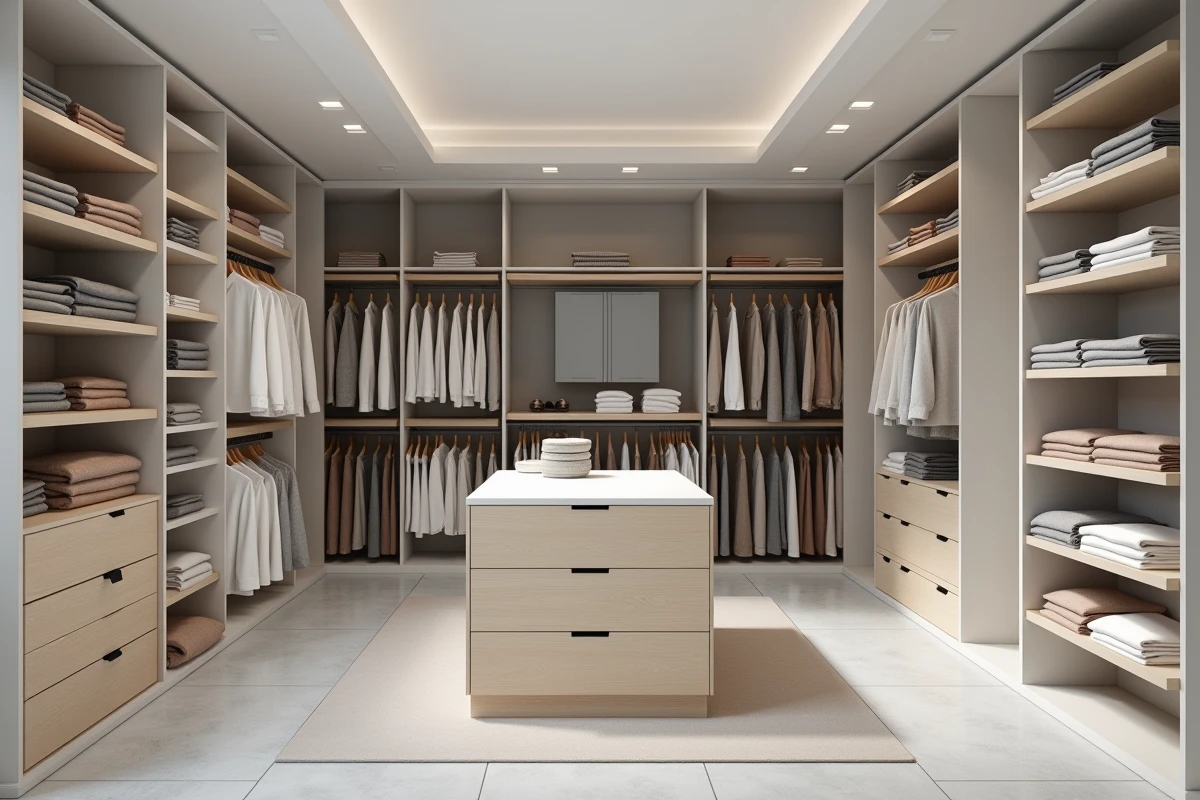
A poorly designed dressing room is quickly noticeable: doors that hit the bed, shelves that are too deep where sweaters disappear, and a wardrobe area that is too short for coats. The layout plan determines all the daily comfort of use. Before choosing a finish or color, it’s the arrangement in the room and the internal layout that deserve attention, especially when dealing with limited square meters or atypical volumes like attics.
Under-slope dressing and attics: making the most of lost volumes
Converted attics pose a recurring problem: the height under the slope quickly drops below the useful threshold for a classic wardrobe. You end up with unusable wall triangles if you place a standard piece of furniture against the low wall.
The most effective solution is to reserve the lower area for drawers and shoe storage, then gradually rise towards the high wardrobe on the ridge side. In practice, you draw three parallel bands to the slope: low storage (less than one meter in height), intermediate shelves, and then full-height wardrobe in the center of the room.
For really narrow spaces, an L-shaped layout along two adjacent walls avoids blocking circulation. You maintain a clear passage of at least 70 centimeters in front of the facades, allowing you to open a drawer without having to step back to the opposite wall. Returns on this point vary depending on the actual depth of the dressing room, but going below this distance makes usage cumbersome.

Detailed approaches to this type of configuration can be found in Murmures Déco’s decor advice, particularly for adapting the plan to the exact slope of the roof.
Invisible dressing: full-height facades and removal of handles
The most striking trend in bedroom design in recent years is the dressing that disappears into the wall. We talk about full-height facades, with no visible frame, painted exactly the same color as the adjacent partition. The result: from the threshold of the room, you can’t distinguish the closet from the wall.
To achieve this effect, push-pull opening systems that eliminate any visible handles are used. A simple push on the facade releases the door or sliding panel. This choice imposes a constraint: the panels must be perfectly flat, without deformation, which directs you towards rigid and stable materials.
The interest goes beyond decor. An architectural dressing visually clarifies the sleeping space. In a modestly sized bedroom, the absence of a “brought-in” piece of furniture lightens the perception of volume. You gain visual serenity without sacrificing storage.
Choice of panels and indoor air quality
A point rarely addressed in classic layout guides: the panels used to build a closed dressing emit volatile organic compounds, notably formaldehyde. In a closed space like a closet, these emissions stagnate and diffuse into the bedroom with each opening.
Favor low VOC emission panels (minimum E1 class, or better, certified wood panels from sustainable sources) to protect the air quality of the room. This is a concrete selection criterion when comparing low-cost melamine boxes with more demanding solutions.
U-shaped or L-shaped dressing plan: which layout for which room
The choice between an I, L, or U plan directly depends on the shape of the room and the location of the entrance door. Placing a U-shaped dressing in a narrow rectangular bedroom blocks half of the useful volume. Conversely, a simple I-shaped linear layout in a square room leaves three walls empty.
- The L plan is suitable for rectangular bedrooms with an off-center door. It utilizes two perpendicular walls without blocking circulation to the window.
- The U plan works in a dedicated room (an old office, a corner of a master suite). It maximizes the linear storage but requires a minimum comfortable width to circulate in the center.
- The I plan (one wall only) remains the simplest to design and best suited for small spaces. The lack of surface area is compensated by height, with high shelves accessible via a folding step stool.
In all cases, start by tracing the plan on the floor with the actual dimensions of the room, incorporating obstacles: radiator, electrical outlet, skylight. Drawing the dressing on graph paper or using an online planning tool allows you to anticipate conflicts between closet doors and the room door.
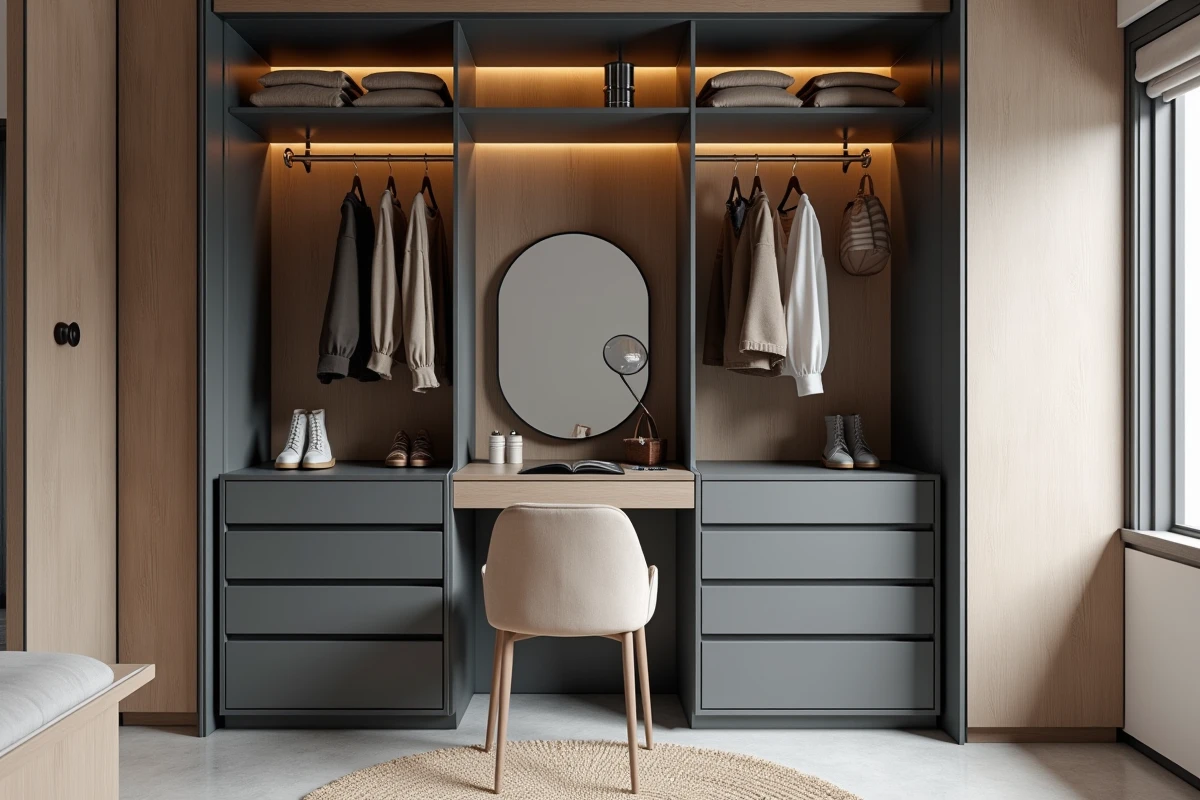
Internal layout of the dressing: optimizing every centimeter
The classic mistake is to fill the entire interior with hangers. In reality, most clothes fold better than they hang (sweaters, t-shirts, jeans). A good internal distribution combines three types of storage in proportions suited to your actual wardrobe.
- High wardrobe (minimum 1.60 m of free height) for coats, dresses, and long jackets. It should be limited to one section, not the entire dressing.
- Mid-height wardrobe (about 1 m) for shirts, blazers, and skirts. Below, place a block of drawers or a shoe rack.
- Open shelves and drawers for everything else: folded linen, accessories, bags. Drawers prevent dust accumulation, while shelves offer immediate visual access.
A detail that changes daily life: plan for a buffer space near the entrance of the dressing, even if it’s reduced to a simple hook or a short rail. This is where you place worn clothes that are not yet ready for washing, without cluttering the clean shelves.
The last point to decide is the lighting. A closed dressing without integrated light becomes a black hole where navy blue and black are confused. A simple LED strip fixed under each high shelf is enough to make each section readable, without heavy electrical installation.