Choosing a machine to sow grass involves balancing three rarely compared variables: the area to cover, the quality of soil preparation, and the noise level tolerated by the neighbors. This article compares the main available equipment, from simple manual spreaders to combined turf machines, based on their technical characteristics and real usage constraints.
Turf machine, spreader, tiller: comparative table of sowing machines
The choice of a machine for sowing grass depends as much on the type of terrain as on the budget. The table below summarizes the functional characteristics of the most common equipment.
| Machine | Main function | Suitable area | Power source | Access mode |
|---|---|---|---|---|
| Hand spreader | Manual seed distribution | Small areas | None | Purchase |
| Wheeled spreader | Regular band sowing | Medium areas | None | Purchase |
| Tiller | Shallow soil preparation | Small to medium areas | Electric or gas | Purchase or rental |
| Cultivator | Deep soil turning | Large areas | Gas | Purchase or rental |
| Combined turf machine | Frosting + sowing + rolling in one pass | Medium to large areas | Gas | Rental (Kiloutou, Loxam, Locamat networks) |
The most significant difference lies between the spreader (a passive tool that distributes the seed) and the combined turf machine, which prepares, sows, and rolls in a single pass. Between the two, tillers and cultivators do not sow: they prepare the soil before manual or mechanical sowing.
Tiller or cultivator: two approaches to soil preparation
Confusion between tillers and cultivators is still common. However, their roles differ on a specific technical point: the working depth.
The tiller works on the surface, on the first centimeters of soil. Its rotating blades loosen the earth, break clumps, and incorporate a light amendment. It is suitable for already cultivated land or lawn renovations where the soil is not compacted deeply.
The cultivator, heavier, turns the soil at a significantly greater depth. It loosens soil compacted by years of neglect or after construction work. On an unworked clayey terrain, the tiller alone is not sufficient.
- Loose, already cultivated, or sandy soil: the tiller is sufficient for refining before sowing
- Compacted, clayey, or fallow soil: the cultivator is necessary for prior deep turning
- Mixed terrain (compacted and loose areas): a pass with the cultivator on hard areas, then tiller to even out the whole
In all cases, neither the tiller nor the cultivator sows. They are preparation tools. Sowing requires additional equipment: spreader, seeder, or turf machine.
Combined turf machine: the machine that changes the effort-result ratio
Since 2023-2024, manufacturers like Redexim or Blec offer compact models (like “Multiseeder Mini” or “SeedCarriage Micro”) designed for gardens of a few hundred square meters. These machines, previously reserved for landscaping professionals, are now available for public rental.
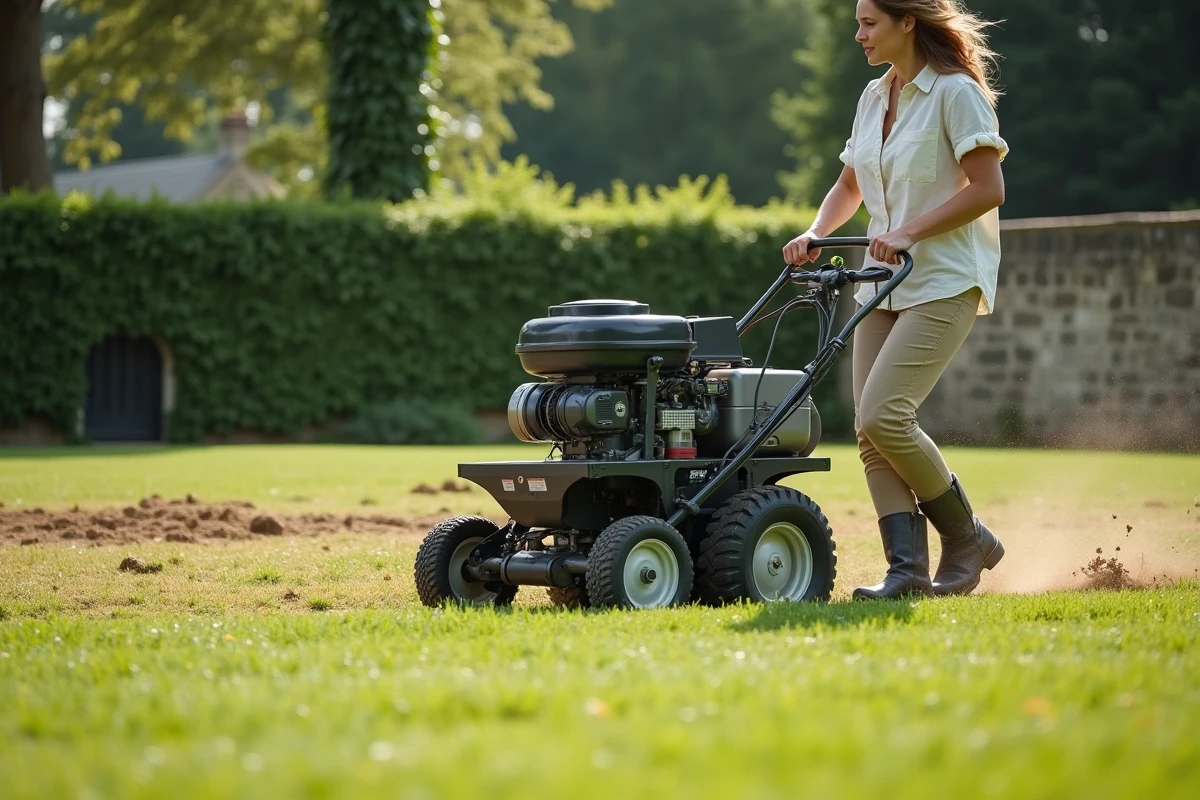
The principle of the combined turf machine is based on three sequential actions: shallow frosting, seed placement, and rolling. The soil is lightly scratched, the seed is deposited at a consistent depth, and then pressed into the ground by an integrated roller. The seed-soil contact, often approximate during a broadcast sowing, becomes systematic here.
However, the turf machine does not replace a proper foundational work on compacted soil. If the terrain has never been prepared, a prior pass with the cultivator remains necessary. The turf machine excels on already loosened soil or for overseeding on existing grass.
Rental rather than purchase for individuals
The purchase cost of a gas turf machine makes it less relevant for occasional use. Rental networks (Kiloutou, Loxam, Locamat) offer these machines by the day, which largely covers the time needed for a standard-sized garden. Allow for a morning to treat an average area, including delivery and adjustments.
Noise from gas machines and local regulatory constraints
Cultivators, scarifiers, and gas turf machines produce a high noise level. Since 2022, several French municipalities have strengthened their regulations on noise pollution, with strict time slots in dense residential areas. The use of these machines is often prohibited in the evening and on Sunday afternoons.
This constraint directly impacts the choice of equipment. A gas cultivator usable only between 9 AM and 12 PM on Saturdays reduces the working window to a few hours. Two options emerge:
- Favor an electric power source for the preparation phase (electric tiller), which is quieter and usable during broader time slots
- Concentrate the gas use on short-term rentals, planning the work during an authorized time slot
- Check the applicable prefectural or municipal order before any equipment reservation
The choice between gas and electric is therefore not limited to power. Local regulations can render a gas machine unusable during the planned time slot, turning a theoretical power gain into a real time loss.
Hand spreader or wheeled spreader: the right tool for small lawns
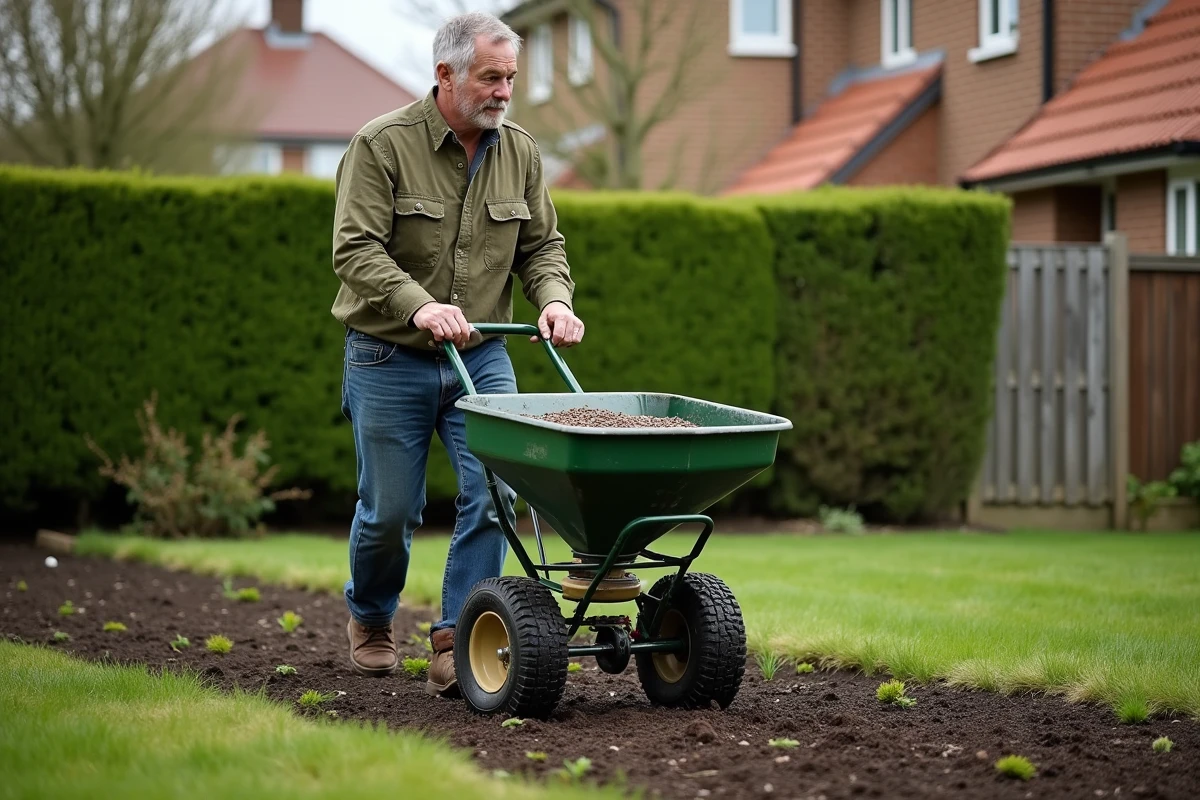
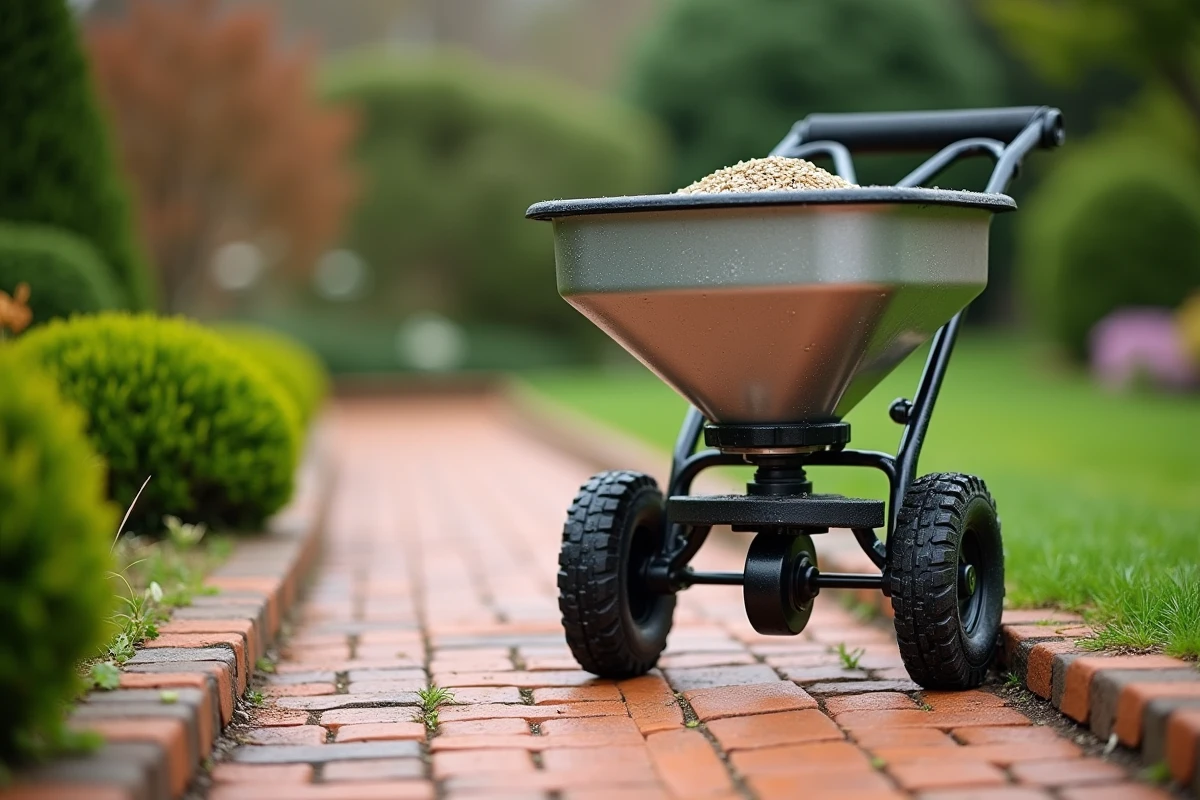
For small gardens, the spreader remains the simplest tool. The hand spreader projects seeds by rotating a disk driven by a crank. The wheeled spreader, pushed like a lawn mower, distributes seeds in parallel bands with an adjustable flow rate.
The regularity of sowing is the main difference between the two. The wheeled spreader produces a more homogeneous coverage, reducing areas of over-density or deficiency. On a flat and already prepared surface, it gives a result comparable to that of a turf machine, provided the ground is rolled manually after sowing.
The determining criterion remains the area. Beyond a few hundred square meters, the hand spreader becomes tedious, and sowing loses its regularity. The wheeled spreader then takes over, but without preparing or rolling the soil.
The most suitable machine is not the most powerful or the most expensive. It is the one that corresponds to the actual state of the soil, the size of the garden, and the time constraints imposed by local regulations. A wheeled spreader is sufficient for a small well-prepared garden.
A combined turf machine for rent resolves in a morning what would take an entire weekend with manual tools. The right decision is made based on these three criteria, not on the technical sheet.